
Tax rules can change from year to year, and 2026 is no exception. Several important federal tax changes may affect how much Americans owe, how much they can deduct, and how they plan their finances throughout the year.
Some of the biggest changes involve the standard deduction, federal tax brackets, qualified tips, overtime pay, car loan interest, seniors, state and local taxes, retirement contributions, health savings accounts, and charitable donations.
But there is one important point to understand before we begin.
Tax year 2026 is not the same thing as the 2026 tax filing season. Most income earned during the 2026 tax year will generally be reported on tax returns filed in 2027. Some changes created by recent legislation, however, also affected 2025 tax returns filed during the 2026 filing season.
In this guide, we focus mainly on the rules and amounts that apply to tax year 2026 so you can plan ahead.IRS 2026 tax inflation adjustments
«Disclaimer: This article is for general educational purposes and is not tax, legal, or financial advice. Tax rules can depend on your income, filing status, state, and individual circumstances. Always verify your situation with the IRS or a qualified tax professional.»
What Are the Biggest 2026 Tax Changes?
Here are 10 important changes and tax-related updates Americans should know about in 2026:
1. Higher standard deduction
2. Updated federal tax brackets
3. New deduction for qualified tips
4. New deduction for qualified overtime
5. New deduction for qualifying car loan interest
6. New additional deduction for seniors
7. Higher state and local tax deduction limit
8. Higher retirement contribution limits
9. Higher Health Savings Account contribution limits
10. New rules affecting charitable deductions
Let’s look at each one in detail.
1. The Standard Deduction Is Higher in 2026
The standard deduction is one of the most important tax deductions for individual taxpayers because many people use it instead of itemizing individual deductions.
For tax year 2026, the standard deduction increases to: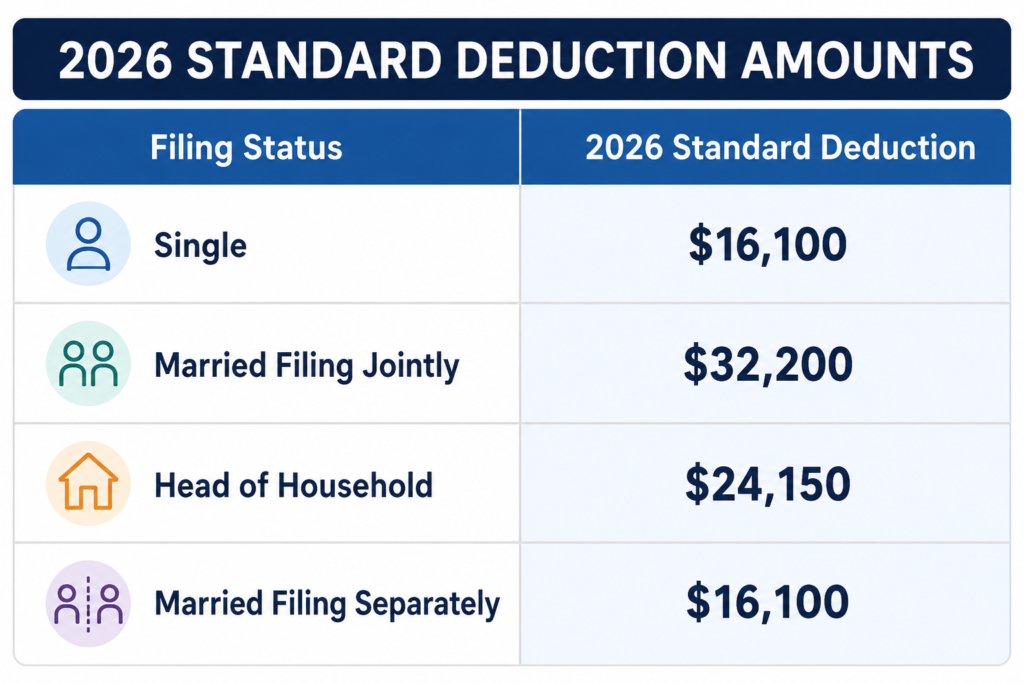
The increase means that more of your income may be excluded from federal taxable income before your tax is calculated.
Tax Filing in USA for Beginners – Complete Step-by-Step Guide (2026)
Why Does the Standard Deduction Matter?
Suppose you are a single taxpayer and have $70,000 of gross income. If you qualify for the standard deduction and have no other adjustments or deductions for this simplified example, the standard deduction reduces the amount of income subject to federal income tax.
That does not mean you automatically save $16,100 in taxes.Instead, the deduction reduces your taxable income.This is an important distinction because a $16,100 deduction does not equal a $16,100 tax refund.
Should You Take the Standard Deduction or Itemize?
For many taxpayers, the standard deduction is simpler. However, some people may benefit from itemizing because of qualifying expenses such as certain state and local taxes, mortgage interest, and charitable contributions.The better option depends on your individual circumstances.
2. Federal Tax Brackets Are Updated for 2026
The federal income tax system in the United States uses marginal tax brackets.For 2026, the federal income tax rates remain:
10%, 12%, 22%, 24%, 32%, 35%, and 37%.
The income thresholds for those brackets are adjusted for 2026.federal tax brackets
For example, for a single filer, the 22% marginal bracket begins above $50,400 of taxable income, while the top 37% rate applies to taxable income above $640,600.For married couples filing jointly, the corresponding thresholds are different.
What Does a Tax Bracket Actually Mean?
A common misunderstanding is that moving into a higher tax bracket means all of your income is taxed at that higher rate.That’s not how the federal marginal tax system works.
For example, if part of your taxable income falls into the 22% bracket, only the income within that bracket is taxed at 22%. Your earlier taxable income is taxed at the applicable lower rates.
Understanding marginal tax brackets can make tax planning much less confusing.
3. Qualified Tips May Qualify for a New Tax Deduction
One of the most talked-about 2026 tax changes involves workers who receive tips.Eligible taxpayers may be able to deduct up to $25,000 of qualified tip income, subject to eligibility requirements and income phaseouts.This provision can be particularly relevant to workers in occupations where tipping is customary.
Is All Tip Income Tax-Free?
No.This is one of the most important points to understand.The phrase “no tax on tips” can make it sound like tipped workers never pay tax on their tips. In reality, the law creates a deduction for qualified tips and has specific requirements.Not every payment received by a worker automatically qualifies.
Who Should Pay Attention to This Rule?
People working in qualifying tipped occupations should keep accurate records of their tip income and make sure their income is properly reported.If you receive tips, don’t simply assume that all of your tip income automatically qualifies for the deduction.Check the current IRS requirements before filing.
4. Qualified Overtime May Also Qualify for a Tax Deduction
Another major change involves qualified overtime compensation.Eligible taxpayers may be able to deduct up to:
– $12,500 of qualified overtime compensation
– $25,000 for married couples filing jointly
Income limitations and eligibility rules apply.
This could be particularly relevant for employees who regularly work overtime.
Does This Mean Overtime Is Completely Tax-Free?
No.Just like the tip deduction, the overtime provision does not mean every dollar of overtime pay is automatically exempt from federal taxes.The deduction applies to qualified overtime compensation under the applicable rules.
Why Should Overtime Workers Pay Attention?
If you work overtime, keep your pay records and review your W-2 or other applicable tax documents carefully.It is also worth checking your federal tax withholding during the year rather than waiting until tax filing time.
5. A New Deduction May Apply to Qualifying Car Loan Interest
For some Americans, one of the most interesting 2026 tax changes involves vehicle financing.
Eligible taxpayers may be able to deduct up to $10,000 of qualified passenger vehicle loan interest.However, the vehicle and loan must meet specific requirements.
For example, the rules generally require the loan to have been originated after December 31, 2024, and the vehicle must meet the applicable requirements for a qualifying passenger vehicle purchased for personal use.Lease payments do not qualify for this particular deduction.
Who Could Benefit?
This provision could be relevant if you recently purchased a qualifying vehicle using a loan and paid interest during the year.Before claiming the deduction, check whether your vehicle, loan, purchase date, and personal-use requirements satisfy the IRS rules.
Keep Your Loan Documents
If you think you qualify, keep:
– Your auto loan agreement
– Interest statements
– Vehicle purchase documents
– Vehicle identification number
– Other records showing that the loan and vehicle meet the requirements
Good recordkeeping can make tax filing much easier.
6. Seniors May Qualify for an Additional $6,000 Deduction
Americans age 65 and older may have another tax benefit to consider in 2026.Eligible seniors may qualify for an additional deduction of up to $6,000 per person.For a married couple filing jointly, both spouses may potentially qualify, meaning the combined deduction could reach $12,000 if both meet the requirements.However, the deduction is subject to income limitations.
Who Can Claim the Senior Deduction?
Eligibility depends on factors including age, filing status, income, and Social Security number requirements.The deduction can generally be claimed whether the taxpayer takes the standard deduction or itemizes, provided the applicable requirements are met.
Why Is This Important?
Retirees often have income from several sources, such as:
– Social Security
– Pensions
– 401(k) withdrawals
– IRA distributions
– Investment income
– Part-time employment
Because taxable income can vary significantly from one retiree to another, this additional deduction could be useful for eligible taxpayers.
7. The SALT Deduction Limit Is Higher in 2026
SALT stands for state and local taxes.
For taxpayers who itemize deductions, the federal deduction limit for qualifying state and local income, sales, and property taxes is higher in 2026.The 2026 limit is $40,400, although income-based limitations can reduce the benefit for higher-income taxpayers.
For married taxpayers filing separately, the limit is $20,200.
What Is the SALT Deduction?
The SALT deduction can include certain qualifying:
– State income taxes
– Local income taxes
– State and local sales taxes
– Real property taxes
– Personal property taxes
However, not every state or local tax is deductible.
Who Is Most Likely to Care About This Change?
The higher SALT limit may be particularly relevant to homeowners and taxpayers who live in states or areas with relatively high state and local taxes.If you itemize deductions, compare your potential itemized deductions with the standard deduction before deciding which approach is more beneficial.
8. Retirement Contribution Limits Increase in 2026
Tax planning isn’t only about deductions you claim when filing your return.Your retirement contributions can also play an important role in your long-term financial plan.
For 2026, the employee contribution limit for many 401(k), 403(b), governmental 457 plans, and the federal Thrift Savings Plan increases to $24,500.The IRA contribution limit increases to $7,500.For eligible workers age 50 and older, additional catch-up contributions may be available.There is also a higher catch-up contribution limit for certain workers ages 60 through 63 under applicable rules.IRS senior tax deduction rules
Why Does This Matter?
If your employer offers a 401(k), increasing your contribution can potentially help you:
– Build retirement savings
– Take advantage of an employer match
– Reduce taxable income when using a traditional pre-tax retirement account
– Build long-term financial security
Of course, the tax treatment depends on the type of retirement account and your individual circumstances.
Don’t Ignore Your Employer Match
If your employer offers a 401(k) match, check whether you are contributing enough to receive the full available match.Leaving an available employer match unused can mean missing out on part of your compensation.
9. Health Savings Account Limits Increase in 2026
Health Savings Accounts, commonly called HSAs, can provide another valuable tax-planning opportunity for eligible Americans.
For 2026, the HSA contribution limit is:
– $4,400 for self-only coverage
– $8,750 for family coverage
To contribute to an HSA, you generally must meet the eligibility requirements, including having qualifying high-deductible health plan coverage.
Why Are HSAs Important?
HSAs can offer significant tax advantages for eligible individuals.Depending on the circumstances, contributions may be deductible, investment growth can be tax-free, and withdrawals used for qualified medical expenses can generally be tax-free.That combination makes HSAs an important account to understand if you are eligible.
Who Should Consider an HSA?
If you have a qualifying high-deductible health plan, check whether your employer offers an HSA and whether you can benefit from contributing.Even a relatively small contribution can add up over many years.
10. Charitable Contribution Rules Change for Some Itemizers
Charitable giving remains an important tax consideration, but taxpayers who itemize should be aware of a change beginning with tax year 2026.For certain itemized charitable contribution deductions, only contributions exceeding 0.5% of adjusted gross income (AGI) are deductible.
For example, if your AGI were $100,000, 0.5% would be $500.That means the first $500 of qualifying charitable contributions would not be deductible under this particular rule, while eligible contributions above that amount could potentially qualify.
Keep Records of Charitable Donations
If you donate to qualifying organizations, keep proper documentation.
Depending on the donation, records can include:
– Receipts
– Bank statements
– Written acknowledgments
– Donation letters
– Records of non-cash contributions
Don’t wait until tax season to search for donation records.Create a simple folder throughout the year and keep your documentation organized.
How Could the 2026 Tax Changes Affect Your Tax Refund?
A tax deduction does not automatically mean you will receive the same amount as a refund.
Your final tax result depends on several factors, including:
– Total income
– Taxable income
– Filing status
– Tax deductions
– Tax credits
– Federal tax withholding
– Estimated tax payments
– Other applicable tax rules
For example, if a new deduction reduces your taxable income, your overall federal tax liability may decrease.But whether that results in a larger refund depends partly on how much tax you already had withheld or paid during the year.
That’s why two people with similar incomes can receive very different refunds.
How to Save Money on a Low Salary in USA (Realistic Budgeting Tips for 2026)
2026 Earned Income Tax Credit (EITC) Limits
The Earned Income Tax Credit (EITC) is a valuable federal tax credit for eligible low- and moderate-income workers and families. The amount you may receive depends on factors such as your income, filing status, and the number of qualifying children.
For tax year 2026, the maximum EITC ranges from $664 for eligible taxpayers with no qualifying children to $8,231 for those with three or more qualifying children. Income limits and phaseout thresholds also vary depending on filing status and the number of qualifying children.
The table below shows the 2026 EITC income thresholds and maximum credit amounts for eligible taxpayers.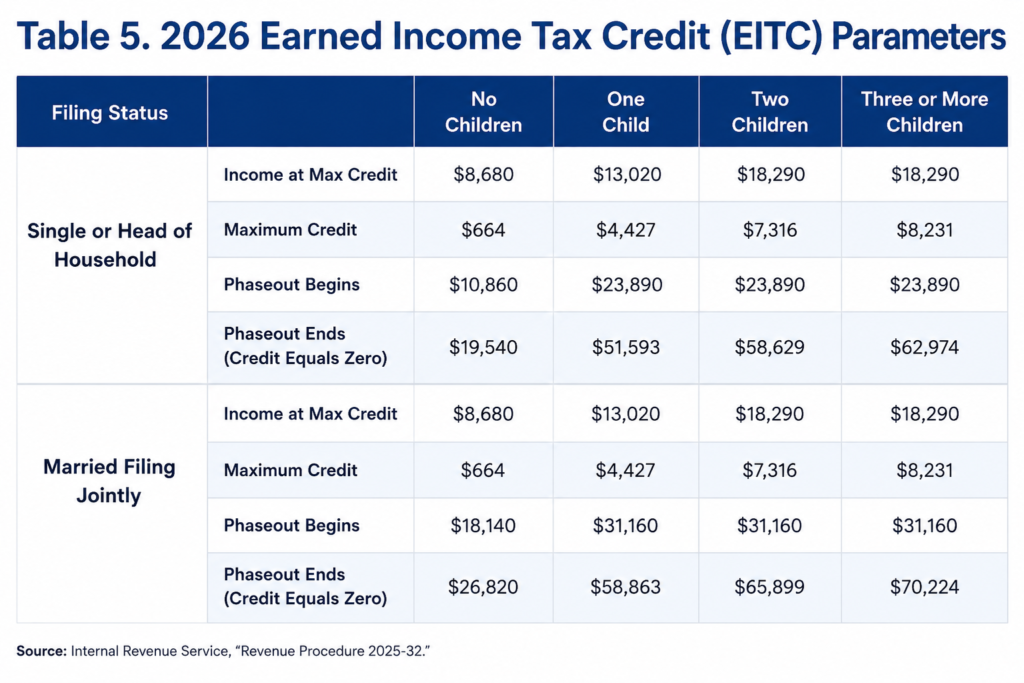
If you think you may qualify for the Earned Income Tax Credit, review the IRS eligibility requirements carefully before claiming it. Your credit can be reduced or eliminated as your income increases, so the maximum credit is not available to every eligible taxpayer.
2026 Tax Changes Based on Your Situation
Not every tax change applies to everyone.
Here’s a quick way to think about which sections may matter most to you.
If You Are a Single Employee
Pay attention to:
– Standard deduction
– Tax brackets
– Retirement contributions
– HSA contributions
– Qualified overtime
– Qualified tips, if applicable
If You Are Married
Pay attention to:
– Married filing jointly tax brackets
– Standard deduction
– Retirement contributions
– Tip and overtime deductions
– Senior deduction, if applicable
– SALT deduction
If You Have Children
Look closely at:
– Child-related tax credits
– EITC eligibility
– Childcare-related tax benefits
– Retirement contributions
– Standard deduction
If You Work for Tips
The qualified tip deduction could be especially important.Keep accurate records and confirm whether your occupation and income meet the requirements.
If You Regularly Work Overtime
Review the qualified overtime deduction and make sure your pay records clearly identify applicable overtime compensation.
If You Are 65 or Older
The additional senior deduction could be particularly important, especially when combined with other deductions and retirement-income planning.
If You Recently Bought a Car
Review whether your vehicle and loan may qualify for the new car loan interest deduction.
How to Prepare for the 2026 Tax Changes
You don’t have to wait until tax season to start preparing.A little organization throughout the year can save time and reduce mistakes.
1. Keep Your Income Records Organized
Save your W-2s, 1099s, investment statements, retirement records, and other income documents.
2. Track Potential Deductions
Don’t rely on memory.Keep receipts and records for expenses that may qualify as deductions.
3. Review Your Tax Withholding
If your income changes significantly, your withholding may need attention.The IRS Tax Withholding Estimator has been updated to account for several of the new deductions and other tax-law changes.
4. Check Your Retirement Contributions
Review your 401(k), IRA, or other retirement contributions and compare them with the applicable 2026 limits.
5. Review Your HSA Contributions
If you have an eligible high-deductible health plan, check whether you are taking advantage of the available HSA contribution limit.
6. Keep Your Tip and Overtime Records
If you receive tips or overtime, make sure the amounts are properly reported and documented.
7. Keep Your Auto Loan Documents
If you think you may qualify for the car loan interest deduction, save your loan and vehicle documents throughout the year.
8. Organize Charitable Donation Records
Keep donation receipts and acknowledgments instead of trying to collect everything at the last minute.
Common Mistakes to Avoid With the 2026 Tax Changes
New tax rules can create opportunities, but misunderstanding them can also create problems.
Mistake 1: Assuming “No Tax” Means Completely Tax-Free
The tips, overtime, and car loan provisions are deductions with specific eligibility requirements.Don’t assume every dollar is automatically tax-free.
Mistake 2: Confusing a Deduction With a Tax Credit
A deduction generally reduces taxable income.A tax credit generally reduces the tax owed directly.They are not the same thing.
Mistake 3: Assuming Everyone Gets the Same Tax Benefit
Tax benefits can depend on income, filing status, age, occupation, and other factors.
Mistake 4: Ignoring Income Phaseouts
Some of the new deductions become smaller or unavailable at higher income levels.Always check the applicable limits.
Mistake 5: Waiting Until Tax Filing Season
Good tax planning happens throughout the year.By the time you file your return, some opportunities to adjust withholding or organize records may already have passed.
15 Critical Personal Finance Mistakes to Avoid today in USA
Frequently Asked Questions About 2026 Tax Changes
What are the biggest tax changes for 2026?
Some of the most notable changes include a higher standard deduction, updated tax brackets, deductions for qualified tips and overtime, a deduction for certain car loan interest, an additional deduction for eligible seniors, and changes to other deductions and contribution limits.
What is the standard deduction for 2026?
For tax year 2026, the standard deduction is $16,100 for single filers, $32,200 for married couples filing jointly, and $24,150 for heads of household.
Is there really no tax on tips in 2026?
Eligible tipped workers may be able to deduct up to $25,000 of qualified tips, subject to income limits and other requirements. This does not mean every dollar of tip income is automatically tax-free.
Is overtime tax-free in 2026?
Eligible workers may be able to deduct up to $12,500 of qualified overtime compensation, or up to $25,000 for married couples filing jointly. Eligibility and income limitations apply.
Can I deduct car loan interest in 2026?
You may be able to deduct up to $10,000 of qualified passenger vehicle loan interest if your loan and vehicle meet the applicable requirements.
What is the new senior tax deduction for 2026?
Eligible taxpayers age 65 or older may qualify for an additional deduction of up to $6,000 per person, subject to income limitations and other requirements.
What are the 2026 federal tax brackets?
The federal tax rates remain 10%, 12%, 22%, 24%, 32%, 35%, and 37%. The income thresholds for each bracket are adjusted for tax year 2026.
What is the SALT deduction limit for 2026?
The 2026 SALT deduction limit is generally $40,400, with a $20,200 limit for married taxpayers filing separately. Higher-income taxpayers may face additional limitations.
How much can I contribute to a 401(k) in 2026?
The basic employee contribution limit for many 401(k) plans is $24,500 for 2026. Additional catch-up contributions may be available to eligible older workers.
How much can I contribute to an HSA in 2026?
The 2026 HSA contribution limit is $4,400 for self-only coverage and $8,750 for family coverage, assuming you meet the eligibility requirements.
When will I file my 2026 tax return?
Income earned during tax year 2026 will generally be reported on a federal tax return filed in 2027. The exact filing deadline depends on IRS rules and your circumstances.
How much federal tax do you pay on $100,000?
There is no single federal tax amount for everyone earning $100,000.Your actual federal income tax can depend on your filing status, standard or itemized deductions, tax credits, retirement contributions, HSA contributions, other income, and other adjustments.
For example, a single taxpayer earning $100,000 and a married couple with a combined income of $100,000 could have very different federal tax liabilities.
It is better to calculate taxable income first rather than simply applying one tax rate to the entire $100,000.
Final Thoughts
The 2026 tax year brings several changes that could affect American workers, families, retirees, homeowners, vehicle buyers, and people saving for retirement.The biggest takeaway is simple: don’t wait until tax season to think about taxes.
If you receive tips or overtime, recently purchased a qualifying vehicle, are age 65 or older, contribute to a 401(k) or HSA, make charitable donations, or itemize deductions, some of these changes may deserve your attention.
At the same time, tax rules can be complicated. A deduction that sounds useful may have income limits or other eligibility requirements.
The best approach is to keep your financial records organized, review your withholding during the year, understand which deductions and credits you may qualify for, and verify the latest information directly with the IRS before filing.A few minutes of planning now could help you avoid unnecessary surprises when tax time arrives.
Leave a Reply