
15 Critical Personal Finance Mistakes to Avoid: Your Roadmap to Financial Freedom in 2026
Managing money in the United States today feels like navigating a minefield. Between fluctuating interest rates, the rising cost of housing, and the subtle “subscription creep” that drains our bank accounts, it is easier than ever to fall behind. Many Americans work hard every day, yet they find themselves stuck in a cycle of “paycheck-to-paycheck” living.
The truth is, building wealth isn’t just about how much you earn; it’s about how much you keep and how wisely you manage it. Avoiding common personal finance mistakes is often more important than picking the “next big stock.” In this comprehensive guide, we will break down the pitfalls that are holding you back and provide a clear strategy to secure your financial future.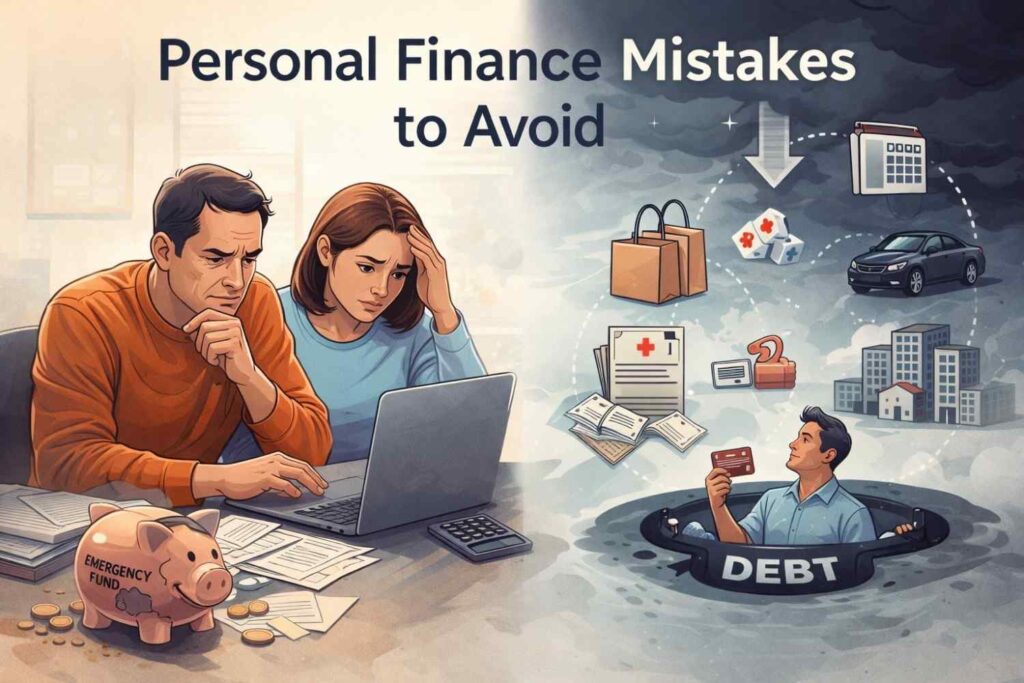
The Psychology of Money and Why We Fail
Before diving into the numbers, we must acknowledge that personal finance is 80% behavior and only 20% head knowledge. Most personal finance mistakes stem from psychological triggers: the need for status, the fear of missing out (FOMO), or simply a lack of financial education.
In the USA, our culture is built on consumption. From the “Buy Now, Pay Later” (BNPL) buttons on every website to the constant barrage of luxury lifestyle ads on social media, the system is designed to keep you spending. To win, you must develop a “wealth-first” mindset.CFPB…
Foundational Personal Finance Mistakes
Operating Without a Written Budget
If you don’t have a budget, you are essentially driving a car in the dark without headlights. You might be moving, but you have no idea where you are headed or what obstacles are in front of you. A common personal finance mistake is thinking, “I know what I spend in my head.”
Data shows that people who track their expenses spend 20% less on average than those who don’t. In 2025, use tools like YNAB (You Need A Budget), Mint, or a simple Excel sheet. Follow the 50/30/20 Rule:
- 50% for Needs (Rent, Groceries, Utilities)
- 30% for Wants (Dining out, Hobby, Netflix)
- 20% for Financial Goals (Savings, Debt Repayment)
The Absence of an Emergency Fund
In the US, a single medical emergency or an unexpected car transmission failure can derail an entire year of progress. One of the most dangerous personal finance mistakes is investing in the stock market before having an emergency fund.
Aim for a “Starter Emergency Fund” of $1,000 to $2,000 immediately. Once your high-interest debt is gone, build this up to cover 3 to 6 months of living expenses. Keep this money in a High-Yield Savings Account (HYSA) so it earns interest while remaining liquid.
Best High-Yield Savings Accounts in USA: Highest APY Rates, Top Banks & Features
Debt: The Silent Wealth Killer
Carrying High-Interest Credit Card Balances
Credit cards are the most effective tool for financial destruction if used incorrectly. With average APRs hovering around 24%, carrying a balance is a financial emergency. If you owe $5,000 on a card at 24% interest and only pay the minimum, you will end up paying thousands in interest alone over several years.
To avoid this personal finance mistake, stop using the cards until the balance is zero. Use the Debt Avalanche method: list your debts by interest rate and attack the highest rate first while paying minimums on the rest.
Financing a Car You Can’t Afford
The “average” car payment in the USA has climbed to over $700 a month. Many people buy a vehicle based on the monthly payment rather than the total price. This is a massive trap. A car is a depreciating asset—it loses value the moment you drive it off the lot. Financing a luxury SUV while you have zero retirement savings is a classic personal finance mistake.
Student Loan Complacency
While student loans often have lower interest rates than credit cards, they are not “invisible.” Ignoring them or constantly putting them in forbearance leads to interest capitalization, where your balance grows even when you aren’t looking. Create a repayment plan that targets the principal balance aggressively.
Best Online Banks in USA 2025:No Fees,High Interest&Safe
Investment Traps and Retirement Risks
Waiting Too Late to Start
The most powerful force in finance is Compound Interest. If you invest $500 a month starting at age 25, you could have over $1.5 million by age 65 (assuming a 7% return). If you wait until age 35 to start, you’ll have less than half that amount. Delaying is a personal finance mistake you can never truly recover from because you cannot buy back time.
Ignoring the Employer 401(k) Match
If your company offers a 401(k) match and you aren’t contributing enough to get it, you are literally throwing away free money. It is a 100% return on investment. Always contribute at least enough to get the full match before putting money anywhere else.
Emotional Investing and Panic Selling
The stock market is a rollercoaster. A major personal finance mistake is checking your portfolio every day and selling when the market dips. Long-term wealth is built by “time in the market,” not “timing the market.” Avoid the hype of meme stocks or crypto-scams; stick to low-cost S&P 500 index funds.
Lifestyle Pitfalls in the Modern Age
Lifestyle Creep (The “I Deserve This” Trap)
You got a $10,000 raise, and suddenly you need a bigger apartment and a better gym membership. This is lifestyle creep. To build wealth, your income should grow faster than your expenses. When you get a raise, divert 50% of it directly into savings or investments before you ever “see” it in your checking account.
How to Control Overspending: Best Practical Ways to Stop Spending Money & Save More
Neglecting Insurance
Being “uninsured” or “underinsured” is a huge risk. A single lawsuit or house fire can wipe out decades of savings. Ensure you have:
- Term Life Insurance (if you have dependents)
- Health Insurance
- Renter’s/Homeowner’s Insurance
- Disability Insurance (to protect your ability to earn an income)
Advanced Wealth Management Mistakes
Not Talking About Money with a Spouse
Financial infidelity—hiding debt or spending from a partner—is a leading cause of divorce in the US. If you are in a relationship, your goals must be aligned. Set a “Money Date” once a month to review the budget together.
Focusing on Saving But Not Earning
You can only cut your expenses so far; you can’t save your way out of a $30,000 income. While frugality is great, failing to invest in your skills or a side hustle to increase your “Top Line” income is a personal finance mistake that limits your ceiling.
How to Build Credit Score in USA From Scratch 2025
30-60-90 Day Action Plan: Fix Personal Finance Mistakes Step-by-Step (2026)
Reading about personal finance mistakes is useful — but real change happens only with action. To help you move from information to implementation, here is a simple 30-60-90 day roadmap designed for the U.S. financial system in 2026.
First 30 Days: Build Stability
Focus: Stopping financial leaks
- Create a written budget (50/30/20 or zero-based).
- Track every expense for one full month.
- Cancel unused subscriptions and memberships.
- Save your first $1,000 starter emergency fund in a high-yield savings account.
- Stop using credit cards if you’re carrying a balance.
Goal: Regain control and stop living reactively.
Next 60 Days: Kill Bad Debt
Focus: Reducing financial stress
- List all debts with interest rates.
- Start the Debt Avalanche method (highest APR first).
- Set automatic payments to avoid late fees.
- Contribute enough to your 401(k) to get the full employer match (free money).
- Review insurance coverage (health, auto, renters/life).
Goal: Reduce interest drain and protect your income.
Final 90 Days: Build Wealth Systems
Focus: Long-term growth
- Increase emergency fund toward 3–6 months of expenses.
- Open or fund a Roth IRA if eligible.
- Start investing in low-cost S&P 500 index funds.
- Increase savings rate whenever income rises.
- Schedule a monthly money review
Goal: Move from survival mode to wealth-building mode.
Frequently Asked Questions (Q&A)
Q1: What are the most common personal finance mistakes for beginners in the USA?
A: Most beginners fail to create a written budget, ignore their employer’s 401(k) match, and rely too heavily on high-interest credit cards for lifestyle expenses. Another major error is not building a “starter” emergency fund of at least $1,000 before investing in risky assets like crypto or individual stocks.
Q2: How can I improve my credit score fast in 2026?
A: The fastest way is to lower your credit utilization ratio (keep it below 30%) and ensure 100% on-time payments. In 2026, tools like “Experian Boost” or “UltraFICO” can also help by including utility and rent payments in your credit history, which were traditionally ignored by lenders.
Q3: What is the 50 30 20 Budget rule in personal finance?
A: It is a simple budgeting framework designed for balance: 50% of your income goes to Needs (rent, groceries, utilities), 30% to Wants (entertainment, dining out), and 20% to Financial Goals (debt repayment, emergency savings, and retirement).
Q4: Is it better to pay off debt or save for an emergency first?
A: Experts recommend saving a $1,000–$2,000 “starter” emergency fund first. This prevents you from taking on new debt when an unexpected expense arises. Once that cushion is in place, use the “Debt Avalanche” or “Debt Snowball” method to aggressively pay off high-interest credit cards.
Q5: Are high-yield savings accounts (HYSA) worth it in 2026?
A: Absolutely. Unlike traditional savings accounts that pay 0.01%, an HYSA can offer 4% to 5.5% interest. It is the best place to park your emergency fund to ensure your money keeps up with inflation while remaining liquid and safe.
Q6: What is “Lifestyle Creep” and how does it prevent wealth?
A: Lifestyle creep happens when your expenses increase as your income rises. Instead of saving a raise, you buy a more expensive car or house. This is a “wealth killer” because it keeps you in a cycle of working more just to sustain a more expensive life, preventing true financial independence.
Q7: How much of my income should I invest in the S&P 500?
A: Aim to invest at least 15-20% of your take-home pay. For long-term growth in the USA, low-cost S&P 500 index funds are highly recommended because they offer instant diversification across the 500 largest US companies, historically returning about 7-10% annually.
Q8: What is the difference between a Roth IRA and a 401(k)?
A: A 401(k) is usually employer-sponsored and often includes a “company match” (free money). A Roth IRA is an individual account where you contribute after-tax money, meaning your withdrawals in retirement are 100% tax-free. Utilizing both is a top strategy for tax-efficient wealth building.
Q9: How do I avoid “subscription creep” and hidden fees?
A: Audit your bank statements monthly. Many Americans lose $200+ monthly on forgotten streaming services and apps. Use tools like Rocket Money to track subscriptions, or manually cancel anything you haven’t used in the last 30 days to save thousands annually.
Q10: Should I use “Buy Now, Pay Later” (BNPL) services?
A: While BNPL (like Affirm or Klarna) feels convenient, it is a psychological trap that encourages overspending. Missing a single payment can lead to high fees and damage your credit score. If you can’t afford to pay in full today, it’s best to save up rather than financing small purchases.
Conclusion
Building wealth is a marathon, not a sprint. By avoiding these personal finance mistakes, you are putting yourself in the top 10% of earners who actually keep what they make. Start today by picking one mistake—perhaps the lack of a budget or the high-interest credit card debt—and tackle it head-on.
Your future self will thank you for the discipline you show today. Financial freedom isn’t about being rich; it’s about having the power to choose how you spend your time.
Leave a Reply